Research

I use global and regional mantle convection models, constrained by data assimilation, to connect deep-mantle processes with what we observe at the surface. A common thread runs through these projects: reconstructing how subducted slabs sink, stagnate, and interact with plumes — and how that history is written into lithospheric structure, magmatism, seismic anisotropy, and topography.


Animated global thermal-chemical mantle convection model with data assimilation

Global data-assimilation models

I build global thermal–chemical convection models that assimilate plate-motion histories, so the simulated present-day mantle reproduces seismic tomography. This lets me follow the evolution of large low-shear-velocity provinces (LLSVPs), the interplay between rising plumes and sinking slabs, and the surface topography they generate — each tested against independent geological and geophysical observations.
Peng & Liu (2023), Earth-Science Reviews

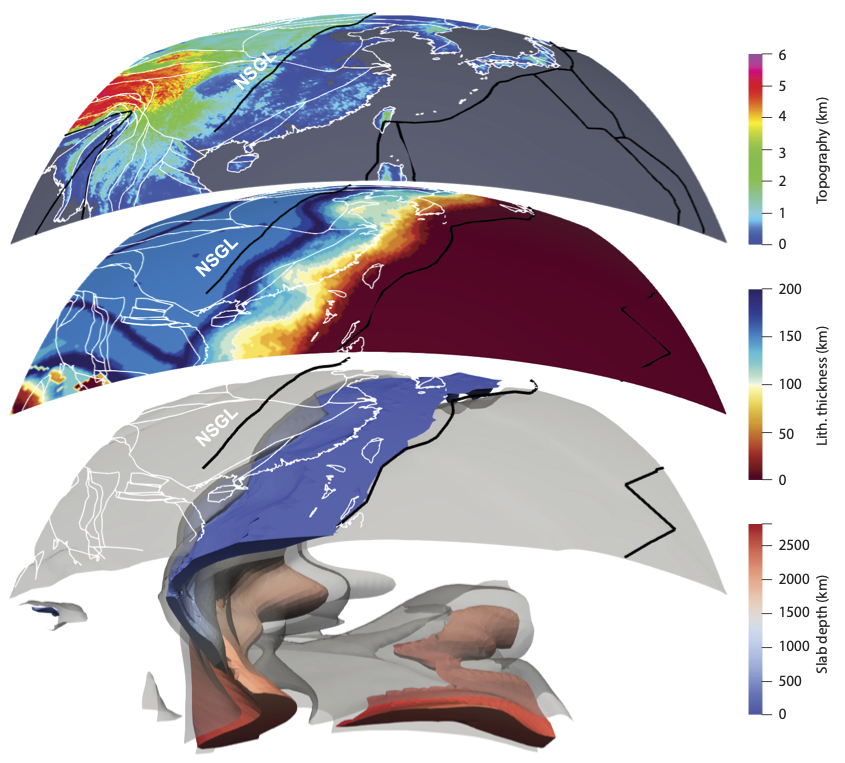
Model of a continental-scale flat Izanagi slab beneath East Asia

The Late Cretaceous flat Izanagi slab

I identified a continental-scale flat Izanagi slab beneath East Asia during the Late Cretaceous. A single, long-lived episode of flat subduction ties together a set of otherwise puzzling regional features — the lithospheric structure, the magmatic record, and the pattern of surface uplift and subsidence — and most likely formed through prolonged, shallow-angle subduction.

Peng, Liu & Wang (2021), JGR: Solid Earth

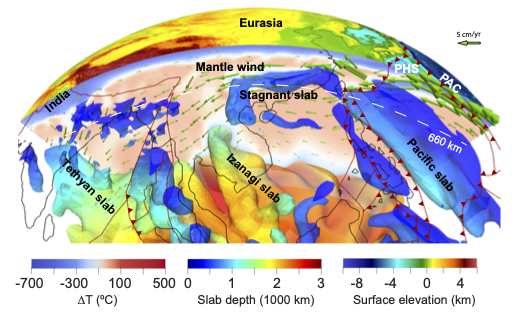
Model of stagnant slabs beneath East Asia driven by a westward mantle wind

Stagnant Pacific & Philippine Sea slabs

The Pacific and Philippine Sea slabs stagnate within the mantle transition zone beneath East Asia. I proposed that a regional, pressure-driven westward "mantle wind" sustains this stagnation, and the seismic anisotropy predicted by the modeled flow matches observations. I also wrote about it for the EGU Geodynamics blog: Why do some slabs stagnate?

Peng et al. (2021), Geophysical Research Letters

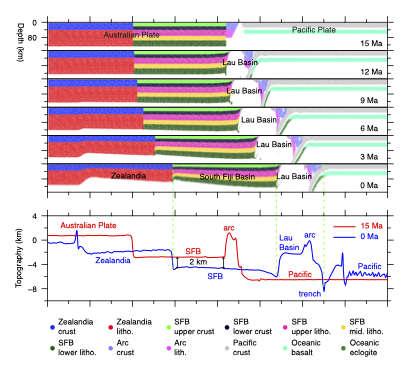
Model of the Tonga-Kermadec subduction zone and the opening of the Lau Basin

The Tonga–Kermadec subduction zone

The Tonga–Kermadec zone has the fastest trench retreat on Earth, which conventional models struggle to reproduce. Using a nonlinear-rheology boundary condition, I recovered both the observed slab geometry and the opening of the Lau back-arc basin, linking the basin's formation to eastward migration of the Lau Ridge.

Peng & Stegman (2024), Geophysical Research Letters

Each project above links to its key paper. For full method details and further work — across these and other topics — see my complete publication list or my Google Scholar profile.